The 2026 FIFA World Cup is set to become one of the most extraordinary tournaments in the history of international football. For the first time, 48 national teams will compete for the most prestigious trophy in the sport, making the competition larger, more diverse and more exciting than ever before. The tournament will also be jointly hosted by three countries—the United States, Canada and Mexico—another important milestone in FIFA World Cup history.
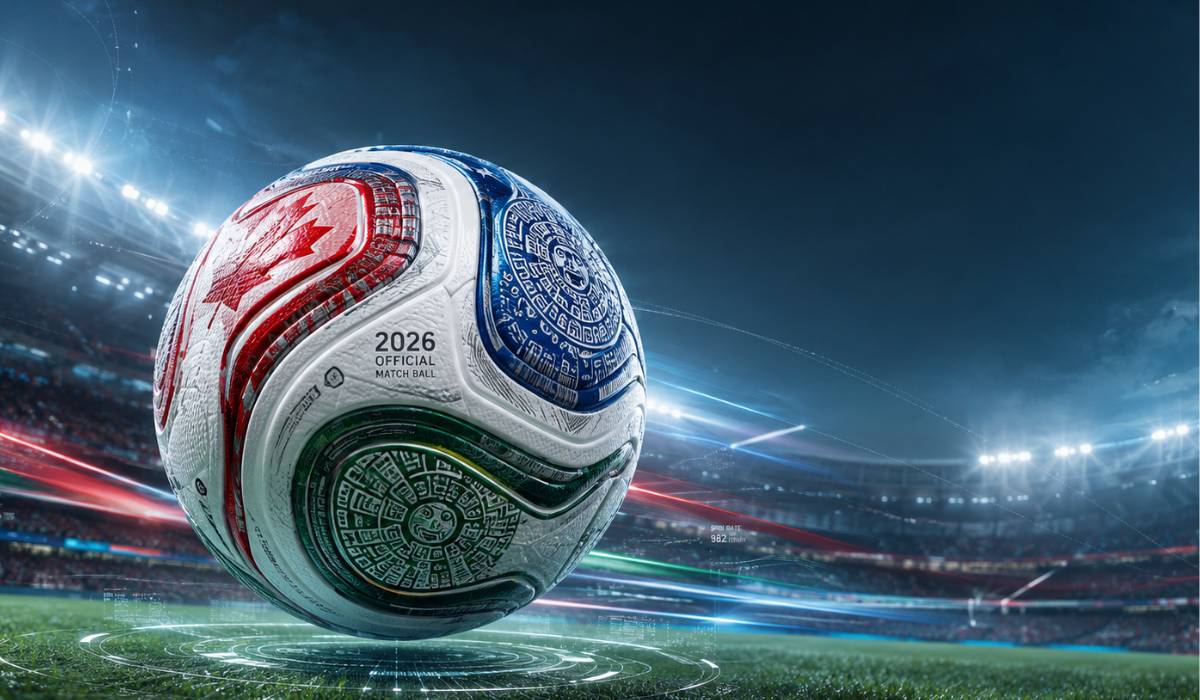
While football fans around the world are eagerly waiting to see their favourite players and national teams in action, another special feature of the tournament has already attracted considerable attention: the official match ball created for the 2026 FIFA World Cup.
The official World Cup ball is not merely a piece of sporting equipment. It represents the identity of the tournament, the culture of the host nations and the technological progress of modern football. Adidas, the long-standing official match-ball supplier for the FIFA World Cup, has once again attempted to combine sporting performance, artistic design and advanced technology in a single product.
The 2026 World Cup ball can therefore be described as much more than a traditional leather football. It is expected to function as an intelligent sporting device—a “smart ball” capable of collecting and transmitting important data during matches.
A Historic Tournament Deserves a Special Ball
Every FIFA World Cup introduces new stories, heroes and unforgettable moments. Some tournaments are remembered for dramatic finals, outstanding players or unexpected victories. Others are remembered for technological innovations and major changes to the competition.
The 2026 tournament will be historic because of its expanded format. Increasing the number of participating teams from 32 to 48 will provide more countries with the opportunity to compete on football’s biggest stage. It will also introduce fans to a wider variety of footballing cultures, playing styles and emerging talents.
With more teams and more matches, the official match ball will play an important role throughout the tournament. Every pass, shot, free kick, penalty and goal will involve the same carefully designed piece of equipment.
The match ball will travel across stadiums in the United States, Canada and Mexico, connecting all three host nations through a shared symbol of football. Its design is intended to reflect the energy of the tournament as well as the cultural diversity of North America.
A Design Inspired by Three Host Nations
One of the most striking aspects of the 2026 FIFA World Cup ball is its artistic design. Hosting the tournament across three countries gives the designers a unique challenge: the ball must represent different national identities while maintaining one unified World Cup image.
The United States, Canada and Mexico each possess rich and distinctive cultural traditions. Mexico is globally recognised for its colourful artistic heritage, ancient civilisations, traditional patterns and passionate football culture. Canada is associated with natural beauty, multicultural communities and a growing football identity. The United States contributes a diverse sporting culture, modern urban energy and a history of hosting major global events.
The ball’s visual identity is expected to bring elements of these three cultures together. Rather than representing one host nation, it acts as a symbol of cooperation among all three countries.
The colours, shapes and patterns used on the ball also reflect the speed and movement of football. When the ball rolls, spins or travels through the air, the design can create a sense of continuous motion. This visual effect supports the fast-paced identity of the modern game.
In this way, the ball becomes a small moving canvas. It combines sporting function with artistic meaning, showing how design can communicate the spirit of an international tournament.
From a Traditional Football to a Smart Ball
The most important development in the 2026 match ball is not simply its appearance. Its greatest innovation lies inside it.
The ball is equipped with advanced connected-ball technology, including an Inertial Measurement Unit, commonly known as an IMU sensor. This sensor is positioned within the centre of the ball and is designed to measure its movements accurately.
An IMU can detect information such as acceleration, rotation, direction and speed. In football, this means the sensor can record how the ball moves when it is passed, kicked, deflected or controlled by a player.
According to the technological concept described for the ball, data can be transmitted to the Video Assistant Referee system hundreds of times per second. Such a rapid flow of information allows match officials and supporting technologies to identify the exact moment at which a player touches the ball.
This may seem like a small detail, but it can be extremely important when making decisions in professional football.
For example, an offside decision often depends on two precise moments: the position of the attacking player and the exact instant when a teammate plays the ball. Even a delay of a fraction of a second can change whether the player appears to be onside or offside.
Traditional video footage may not always clearly identify the exact contact point between the player’s foot and the ball. However, a sensor inside the ball can help record that moment with greater accuracy. When this information is combined with camera-based player-tracking systems, officials can make faster and more reliable decisions.
Improving VAR and Offside Decisions
The Video Assistant Referee system was introduced to reduce major refereeing mistakes. It can assist officials with goals, penalties, red-card incidents and cases of mistaken identity. However, VAR has also received criticism because some reviews take too long and interrupt the natural flow of matches.
Offside decisions have been particularly controversial. In many cases, viewers must wait while officials study video frames and draw digital lines across the field. Even after the decision is announced, some supporters remain unconvinced.
Connected-ball technology may help solve part of this problem.
By identifying the precise moment the ball is played, the system can provide an accurate reference point for semi-automated offside technology. Stadium cameras can then track the positions of players at that exact instant.
The purpose is not to remove human referees from the game. Instead, the technology is designed to provide them with better evidence. The final decision will still depend on the laws of football and the interpretation of match officials, particularly in situations where a player’s involvement in active play must be considered.
Nevertheless, faster and more accurate data could reduce uncertainty, shorten delays and improve trust in important decisions.
During a World Cup, a single offside decision can determine whether a team qualifies for the next round, reaches the final or becomes world champion. Therefore, even a small improvement in decision-making technology can have a major impact on the tournament.
Designed for Better Performance
The surface and structure of a football influence how it travels, responds and feels during a match. Professional players require a ball that performs consistently under different conditions, including heat, rain, humidity and strong winds.
The special surface texture of the 2026 match ball is intended to improve control and stability. A well-designed texture can help players maintain contact with the ball while dribbling, passing or shooting.
During dribbling, players make a series of quick and controlled touches. The quality of the ball’s surface can affect how easily they change direction or protect possession under pressure. For long passes, the ball must maintain a predictable flight path while travelling over a significant distance.
The panel design is also important. Modern footballs are no longer always constructed using the traditional pattern of 32 stitched panels. Manufacturers experiment with different panel shapes, bonding methods and surface structures to improve aerodynamics and reduce water absorption.
A ball that remains stable in the air benefits passers and goalkeepers. However, changes in speed, rotation and air pressure can still create movement that makes powerful shots difficult to predict.
Players who understand how the ball behaves may use these characteristics creatively. Long-range specialists can apply spin, dip or curve to their shots. Free-kick takers may attempt to send the ball over or around a defensive wall before making it drop sharply towards the goal.
As a result, the tournament may produce spectacular goals from outside the penalty area.
A New Challenge for Goalkeepers
Although attacking players may enjoy the speed and responsiveness of the new ball, goalkeepers could face a serious challenge.
A rapidly moving ball gives a goalkeeper less time to react. When spin or aerodynamic forces cause the ball to change direction in the air, predicting its final path becomes even more difficult.
Goalkeepers must therefore study the official ball carefully before the tournament. They will need to understand how it reacts to powerful shots, crosses, free kicks and wet playing conditions.
Training sessions will be essential. Goalkeepers may practise catching, punching and parrying the ball from different angles and distances. They may also examine whether the ball bounces differently from previous models.
History has shown that World Cup match balls can become major discussion points among goalkeepers. Some have been praised for their consistency, while others have been criticised for unpredictable movement.
The 2026 ball may therefore influence playing strategies. Teams with strong long-range shooters might attempt more shots from distance, especially if they believe the ball’s movement can trouble goalkeepers.
At the same time, goalkeepers with excellent positioning, anticipation and reaction speed may have an opportunity to demonstrate their quality on the world stage.
Greater Attention to Environmental Responsibility
Modern sporting events are increasingly expected to consider their environmental impact. The production of millions of sporting products requires energy, chemicals, raw materials and transportation. For this reason, manufacturers are under pressure to use more sustainable production methods.
The 2026 match ball places greater emphasis on environmentally responsible materials and manufacturing processes. Water-based adhesives can reduce the use of certain harmful chemical substances commonly associated with industrial production.
The use of recyclable or recycled materials also supports the broader goal of reducing waste and conserving natural resources.
These changes do not mean that performance can be ignored. A World Cup match ball must remain durable, waterproof, balanced and suitable for professional competition. The challenge is to achieve these performance standards while reducing environmental harm.
The ball therefore represents an important idea: technological and sporting progress should be accompanied by environmental responsibility.
Although one football alone cannot solve global environmental problems, its visibility can influence public awareness. Because the World Cup reaches billions of people, even small sustainability messages can receive worldwide attention.
Technology and the Human Side of Football
Some fans are concerned that increasing the use of technology could make football feel less natural. Football has traditionally been celebrated for its simplicity. A ball, a field and two goals are enough to play the game.
However, technology does not necessarily remove the human element from football. The excitement of the sport still depends on players’ creativity, courage, teamwork and decision-making.
The sensor inside the ball cannot score a goal, produce a perfect pass or make a decisive save. It cannot replace the emotions experienced by players and supporters. Its purpose is to provide accurate information and support fair competition.
The 2026 match ball demonstrates how tradition and innovation can exist together. From the outside, it remains the familiar object at the centre of the world’s most popular sport. Inside, however, it contains technology capable of communicating with advanced officiating systems.
This combination reflects the direction in which modern football is developing.
A Symbol of the 2026 World Cup
The official match ball will become one of the most recognisable symbols of the 2026 FIFA World Cup. Children will attempt to recreate the tournament’s greatest goals with replicas of the ball. Supporters will purchase it as a souvenir, while players will hope to create history with it.
The ball may be present during unforgettable penalties, dramatic late winners, record-breaking goals and emotional celebrations. By the end of the competition, its design may become permanently connected with the players and moments that define the tournament.
Ultimately, the 2026 World Cup ball represents more than performance technology. It brings together the identities of three host countries, the development of intelligent officiating, the skill of the world’s best players and a growing commitment to sustainable production.
It is a meeting point between art and engineering, tradition and innovation, and human talent and digital intelligence.
As the world prepares for the expanded 48-team competition, one major question remains: which player and which nation will make the greatest impact using this remarkable ball?
Football supporters across the globe will soon discover the answer when the world’s best teams enter the stadiums of the United States, Canada and Mexico. One thing is certain—the official match ball will be at the centre of every important moment, carrying the speed, emotion and excitement of the 2026 FIFA World Cup.