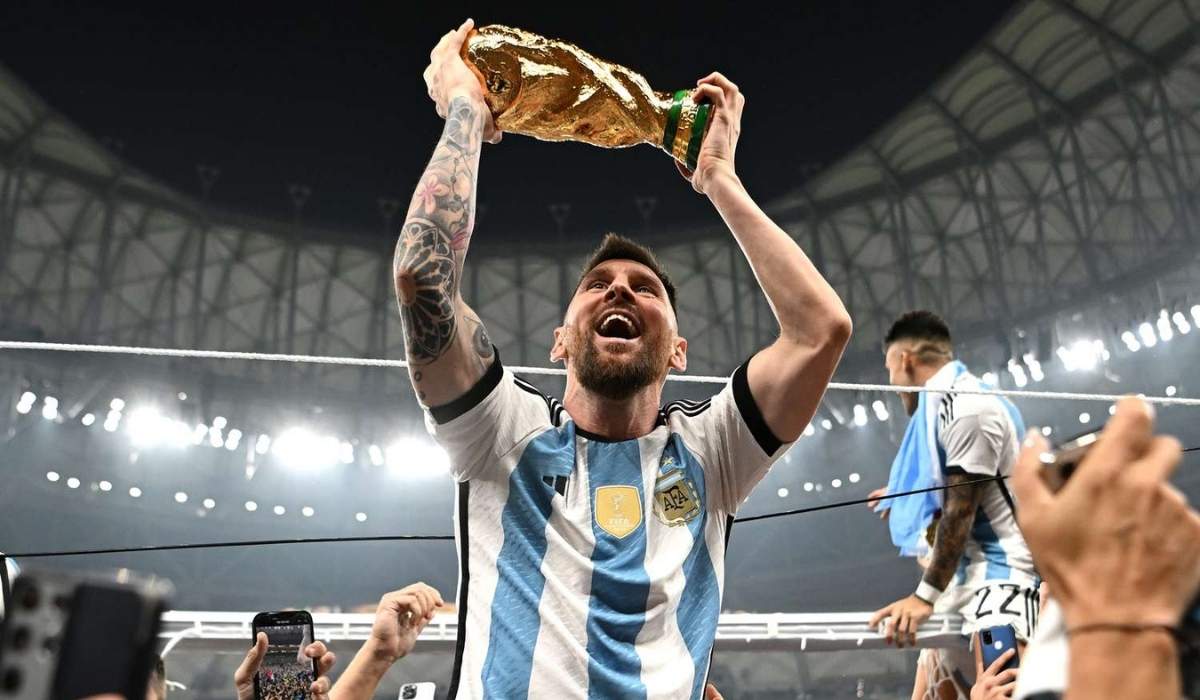
Lionel Messi is preparing for another historic FIFA World Cup challenge, but one major record still stands between him and complete tournament immortality.
The Argentine legend has scored 13 goals across his previous World Cup appearances. Germany’s Miroslav Klose remains the competition’s all-time leading scorer with 16 goals.
That means Messi needs three goals to draw level with Klose and four goals to take the record for himself.
On paper, three or four goals may not appear impossible for a player of Messi’s quality. He scored seven times during Argentina’s victorious 2022 campaign and proved that he could still influence the biggest matches in international football.
However, the 2026 World Cup presents a very different challenge.
Messi is now in the final stage of his extraordinary career. He will face questions about his fitness, playing time, physical condition and ability to produce another outstanding tournament.
This creates one of the World Cup’s biggest individual storylines:
Will Lionel Messi catch Miroslav Klose, or will the legendary scoring record remain beyond his reach?
The Record Messi Is Chasing
Miroslav Klose scored 16 goals across four FIFA World Cups for Germany.
His goals came in the 2002, 2006, 2010 and 2014 tournaments. Klose was not always considered the most naturally gifted striker of his generation, but his movement, positioning and ability to perform in major tournaments made him incredibly effective.
He scored five goals in his first World Cup in 2002, added another five in 2006, scored four in 2010 and completed his record with two goals in 2014.
His final World Cup goal came during Germany’s famous semifinal victory over Brazil. That goal took him beyond Brazilian legend Ronaldo Nazário, who had previously held the record with 15.
Klose later finished his international career as a World Cup champion after Germany defeated Argentina in the 2014 final.
The record has survived ever since.
Several famous players have come close, including Ronaldo, Gerd Müller and Messi. However, nobody has yet reached 16.
Messi now has what may be his final opportunity.
Messi’s World Cup Scoring Journey
Messi scored his first World Cup goal as a teenager in 2006.
He found the net against Serbia and Montenegro after coming on as a substitute, becoming one of the youngest players to score in the competition.
However, his World Cup scoring journey was not always smooth.
Messi failed to score during the 2010 tournament despite producing creative performances for Argentina. Four years later, he scored four goals as Argentina reached the final in Brazil.
The 2014 tournament ended painfully when Germany defeated Argentina after extra time.
Messi scored only once during the 2018 competition, when Argentina were eliminated by France in the round of 16.
At that stage, many supporters wondered whether he would ever win the trophy or produce his greatest World Cup performances.
Everything changed in 2022.
Messi scored seven goals, provided important assists and led Argentina through a dramatic campaign in Qatar. He scored in the group stage, round of 16, quarterfinal, semifinal and final.
Argentina eventually defeated France on penalties, allowing Messi to lift the one trophy that had been missing from his career.
That performance moved his World Cup total to 13 goals and placed Klose’s record within reach.
Why Some Believe Messi Will Break the Record
There are several reasons to believe Messi can score at least four goals during the 2026 tournament.
The first is the expanded tournament format.
The World Cup now includes more teams and an additional knockout round. A nation that reaches the semifinal or final can play as many as eight matches.
More matches create more opportunities for Messi to score.
Argentina are also expected to enter the tournament as one of the strongest teams. If they progress deep into the competition, Messi could receive enough playing time to challenge the record.
He may also continue taking penalties.
Penalty kicks played an important role in his 2022 total. Argentina’s attacking ability and Messi’s movement around the penalty area could create further opportunities from the spot.
His intelligence is another major advantage.
Messi no longer depends entirely on speed. He understands how to find space, control the rhythm of matches and position himself for decisive moments.
Even if he cannot run with the intensity of his younger years, he can still influence games through technique, vision and experience.
Players of Messi’s quality do not require many chances. One free kick, penalty or moment of defensive confusion can be enough.
Why Messi Could Fall Short
Despite his ability, there are realistic reasons why Messi may fail to equal Klose.
The greatest concern is his age.
Messi will be 39 during the tournament. Very few attacking players have remained decisive at that age during a competition as physically demanding as the World Cup.
Recovery between matches becomes more difficult as players grow older. The schedule may require teams to play several matches within a short period.
Argentina’s coaching staff may therefore manage Messi’s minutes carefully.
He could be substituted earlier, rested during less important group matches or used selectively depending on the opponent.
Every minute he misses reduces his opportunities to score.
Fitness will also be closely monitored. Even a minor muscle issue could affect his movement, sharpness and availability.
Messi may still be technically excellent, but World Cup opponents will test him physically. Defenders will attempt to close space quickly and prevent him from receiving the ball near goal.
The record is close, but it is certainly not guaranteed.
Argentina May No Longer Depend on Messi’s Goals
Argentina’s evolution could also affect the record chase.
During previous tournaments, Messi carried much of the attacking responsibility. The team often depended on him to create chances, score goals and rescue difficult situations.
In 2026, Argentina may have a more balanced attack.
Younger players could receive greater responsibility, while Messi may operate as a creator rather than the main finisher.
This tactical change could help Argentina as a team but reduce Messi’s personal scoring numbers.
He may drop deeper to control possession and supply passes to faster forwards. In that role, he could produce assists without entering the penalty area as frequently.
Argentina’s priority will be winning matches, not helping Messi break an individual record.
If another player is better positioned to score, Messi will make the pass. His decisions have always been influenced by the needs of the team.
The record chase will remain important to supporters, but it will not determine Argentina’s tactical plan.
Could Penalties Decide the Record?
Penalty kicks could have a major influence on whether Messi reaches 16 or 17 goals.
Messi is likely to remain one of Argentina’s main penalty takers whenever he is on the field.
During a long tournament, a strong attacking team may receive several penalties. One or two successful spot kicks could move him very close to Klose.
However, depending on penalties also creates uncertainty.
Argentina may not receive many. Messi could also miss one, as even the best players occasionally do.
There is also the possibility that Argentina choose a different penalty taker in certain situations, especially if Messi is not playing the full match.
Some critics may argue that penalty goals make record comparisons unfair. Klose was not Germany’s regular penalty taker during his World Cup career.
Nevertheless, penalties are officially counted like every other goal.
If Messi reaches the record through a penalty, his name will still appear alongside or above Klose in the history books.
Klose’s Record Was Built Differently
Comparing Messi and Klose is difficult because they played different roles.
Klose was a traditional centre-forward. His main responsibility was to position himself inside the penalty area and finish chances.
Messi has spent much of his career creating opportunities as well as scoring them.
He has operated on the right wing, behind a striker and as a false nine. His World Cup contribution cannot be measured only through goals.
Messi has created chances, provided assists, controlled matches and helped Argentina progress through difficult knockout rounds.
Klose’s achievement remains extraordinary, but Messi’s overall World Cup influence is broader.
This means failing to break the record would not damage Messi’s legacy.
He has already won the World Cup, the Golden Ball and numerous major individual honours. His place among football’s greatest players does not depend on scoring four more goals.
The record would be another historic achievement rather than something required to prove his greatness.
The Pressure Could Become a Distraction
As Messi approaches the record, media attention will increase.
Every Argentina match will feature discussions about how many goals he still needs. Every missed chance could become a major headline.
That pressure may affect the way supporters evaluate his performances.
Messi could provide two assists and play brilliantly, yet some people may describe the match as disappointing because he did not score.
This would ignore the wider purpose of the tournament.
Argentina are defending their status as world champions. Their objective is to progress as far as possible and compete for another title.
Messi himself is unlikely to place the individual record above the team.
The media narrative will focus on Klose, but Messi’s decisions on the pitch will remain centred on helping Argentina win.
Ironically, focusing less on the record could improve his chances of reaching it. A relaxed Messi who plays naturally may be more dangerous than one attempting to force shots.
Kylian Mbappé Is Also Chasing Klose
Messi is not the only active player close to the record.
Kylian Mbappé has already scored 12 World Cup goals. The French forward is younger, physically explosive and likely to participate in future tournaments.
Mbappé therefore represents an even greater long-term threat to Klose’s total.
While Messi needs three goals to equal Klose, Mbappé needs four.
This creates an extraordinary race during the tournament.
Messi could become the record holder temporarily, only for Mbappé to catch or pass him later. Both players could also overtake Klose during the same competition.
France and Argentina are strong enough to progress deep into the tournament, giving both stars multiple opportunities.
The presence of Mbappé may reduce some of the pressure on Messi because the record discussion will not focus exclusively on him.
However, it also means Messi may need more than 17 goals to finish the tournament as the permanent leader.
What Happens If Messi Scores Exactly Three?
If Messi scores three goals, he will move from 13 to 16 and join Klose at the top of the all-time list.
He would not become the outright record holder, but equalling a record that has stood since 2014 would still be a historic achievement.
The two players would officially share the highest World Cup goal total.
Some fans might compare the number of matches each player required, their scoring rates or the types of goals they scored.
However, the main record is based on the total number of goals.
To stand alone at the top, Messi must score four.
Reaching 17 would move him beyond Klose and make him the most prolific World Cup scorer in history—unless another player, such as Mbappé, also moves ahead.
What Would Breaking the Record Mean for Messi?
Breaking Klose’s record would add another remarkable achievement to Messi’s career.
He already holds numerous records at club and international level. Becoming the World Cup’s all-time leading scorer would connect his name permanently to the competition’s history.
It would also complete an extraordinary transformation in his World Cup story.
For many years, critics argued that Messi had not reproduced his club success with Argentina. Defeats in major finals became central to discussions about his legacy.
Winning the Copa América and the 2022 World Cup changed that narrative.
Becoming the tournament’s leading scorer would take the transformation even further.
Messi would move from being criticised for his World Cup record to potentially holding its most famous individual scoring achievement.
Few career stories could be more dramatic.
Final Verdict: Will Messi Fail to Catch Klose?
Lionel Messi can catch Miroslav Klose, but doing so will be one of the most difficult challenges of his final international chapter.
Three goals would place him level with Klose’s 16. Four would move him ahead.
The expanded World Cup format, Argentina’s strength and Messi’s penalty-taking ability all improve his chances.
However, age, fitness, managed playing time and tactical changes could prevent him from reaching the record.
Messi may create more goals than he scores. Argentina may also distribute attacking responsibility across a younger generation.
Therefore, failing to catch Klose would not necessarily mean Messi performed badly.
He could still guide Argentina through important matches without scoring four times.
The negative question—whether Messi will fail—is designed to create debate. The reality is that simply reaching another World Cup at 39 and remaining capable of challenging the record is already exceptional.
Klose’s record has survived for more than a decade, but it has never appeared more vulnerable.
Messi is only three goals away from sharing it and four goals away from owning it.
Whether he succeeds or falls short, every Argentina match could become part of World Cup history.